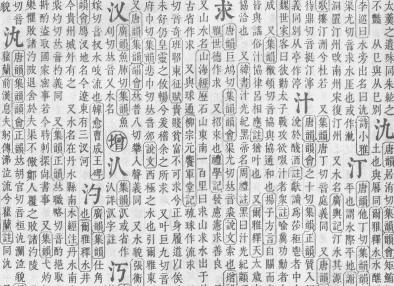
Kanji "radicals" [bushu (部首)] are a way of classifying characters for searching. Radicals are found in all kanji dictionaries, and taught in Japanese schools (see How is Japanese writing taught to Japanese children? for more on Japanese schools). A "radical" is part of the kanji which is found in more than one character. For example, the water-related kanji 汁 [soup; juice], 汚 [dirty], 泡 [bubble], and 泳 [swim] all have the same three-stroke element with the meaning "water" on the left:
There are 214 radicals. The radical system was made popular by a Chinese dictionary, the Kangxi dictionary, known in Japanese as the Kōki Jiten (康煕字典)], published in 1716.
|
|
| A page from the Kangxi dictionary showing kanji for the "water" radical |
|---|
To search for a kanji using the radical system, one first identifies the radical. It is usually either the left [Hen (偏)] or upper [Kanmuri (冠)] part of the character, or a surrounding part which is wrapped around the character [Kamae (構え)].
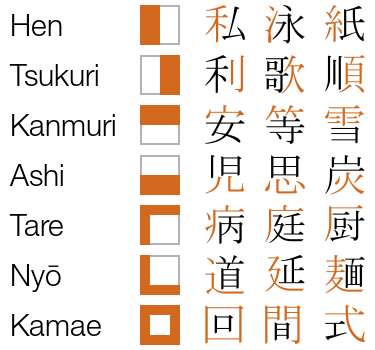
Kanji dictionaries usually have a list of the radicals on their inside covers, ordered by increasing stroke count, which gives the page number of the radical's heading. Under the radical's heading, the kanji are ordered by increasing number of strokes. The usual order of the radicals is shown in What are the names of the kanji radicals? See also How is a kanji dictionary used?
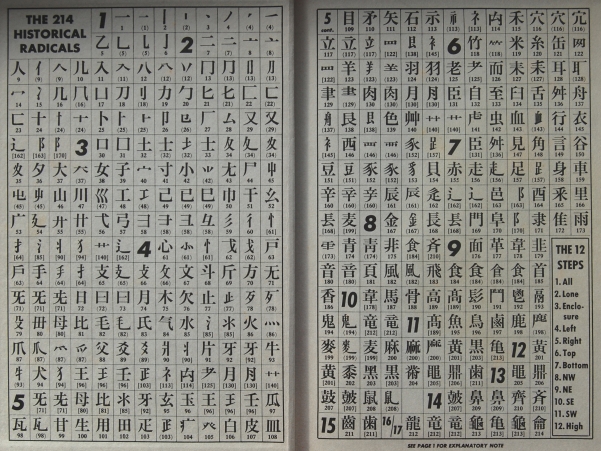 |
| The table of "214 Historical Radicals" from the Nelson Kanji Dictionary |
|---|
The number of kanji which correspond to a particular radical varies quite a lot. Some radicals have hundreds of corresponding kanji, and some have only a handful.
Part of kanji tests such as the Kanji Kentei (see Kanji Kentei) is testing the ability to identify kanji radicals and their names.
The sci.lang.japan FAQ also offers a lookup system via radicals.
About the kanji links: Choose the site for kanji links at the kanji.sljfaq.org options page.
The image from the Kangxi dictionary is courtesy of www.KangXiZiDian.com.
Copyright © 1994-2026 Ben Bullock
If you have questions, corrections, or comments, please contact Ben Bullock or use the discussion forum / News / Privacy policy
|
|
|

|
|
| Book reviews |
Convert Japanese numbers |
Handwritten kanji recognition |
Stroke order diagrams |
Convert Japanese units |