
|
|
| A deliberately out-of-focus photograph |
|---|
| Photo credit: Stig Nygaard / CC licence |
The word "boke", pronounced "bok-ay", and usually written ぼけ or ボケ, has a number of different meanings. It can mean stupid, unaware, or clueless. (See What are some Japanese insults and swear-words? for more.)
This word is also used in photography to mean "deliberately out of focus", and has come into English as "bokeh", with an additional "h" to show the pronunciation. (See What English words come from Japanese? for more words which have come from Japanese to English. See What is the "kwa" in "kwaidan"? for more about non-standard romanization.)
In double-act comedy, the "straight man" is called tsukkomi (ツッコミ) and the "funny man" is called boke.
The Japanese also use boke to mean "senility", and in such compound words as jisaboke (時差ぼけ), "time-lag boke", meaning "jet lag", heiwa-boke (平和ボケ), "peace boke", meaning a state of complacency induced by an excess of peacefulness, and tennen-boke (天然ぼけ), "natural boke", meaning "airhead".
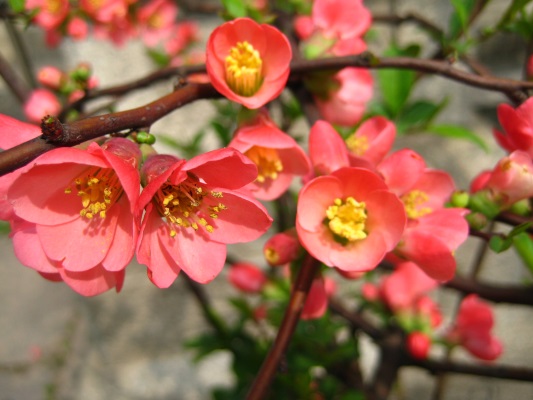 |
| The flowering quince, Chaenomeles speciosa |
|---|
| Photo credit: 清水五月 (Shimizusatsuki) / CC licence |
Boke is also the name of a plant known in English as the Japanese quince or flowering quince, scientific name Chaenomeles speciosa.
Copyright © 1994-2025 Ben Bullock
If you have questions, corrections, or comments, please contact Ben Bullock or use the discussion forum / Privacy policy
|
|
|

|
|
| Book reviews |
Convert Japanese numbers |
Handwritten kanji recognition |
Stroke order diagrams |
Convert Japanese units |