| Try the FAQ's western to Japanese year converter: |
Japanese dates are based on an era system called nengō (年号) in Japanese, corresponding to the reigns of emperors. Here is a table of recent eras. To convert a Japanese date to a Western date, add the number in the 'Add' column to the Japanese year. So, for example, Shōwa 25 is 1925 + 25 = 1950.
| Japanese | Rōmaji | From | Add |
|---|---|---|---|
| 令和 | Reiwa | 2019 | 2018 |
| 平成 | Heisei | 1989 | 1988 |
| 昭和 | Shōwa | 1926 | 1925 |
| 大正 | Taishō | 1912 | 1911 |
| 明治 | Meiji | 1868 | 1867 |
For a more complete list, see Complete list of Japanese eras
Japan started using the Gregorian calendar, the calendar used in most of the world, in Meiji 6, replacing a lunisolar calendar. So the day before January 1 of Meiji 6 (1873) was not December 31, but December 2, of Meiji 5 (1872).
The Japanese traditional calendar, known as the known as Tenpō-reki (天保暦) was on a luni-solar principle, which was copied from China. In a luni-solar calendar, the months are related to the phases of the moon.
In the Chinese lunar calendar, a year consisted of 12 months, or about 354 days, but so that it could start at about the same season every year, an extra "leap month" called an uruuzuki (閏月) or jungetsu (閏月) was inserted about every three years, giving that year 13 months. Since the beginning of a month had to match the new moon, and the seasons must not change drastically, the calendar became very complicated. See also Why do the Japanese use numbers for months?
Ancient Japan imported the Chinese lunar calendar, probably before the 7th century. Before that, for example in the 3th century, Japan was said to count years by observing the seasons.
In 864, Japan adopted one of the Chinese calendars in which a year was defined as 365.2446 days. This calendar was used in Japan until 1699. Meanwhile in China, a more accurate calendar was invented, where a year was defined as 365.2425 days, just the same as the Gregorian calendar. Because of the error in the former calendar, the season drifted slightly, so in 1700 Japan invented her own calendar based on her own astronomic observations. The principle, however, was the luni-solar one, the same as the Chinese one.
In 1868, the Meiji Emperor took back the ruling power from the Tokugawa Shogun (the Meiji Restoration). Many regimes were reformed learning from Western fashions. At the end of 1873, the government announced the adoption of the Gregorian calendar. It is said the true reason was from financial needs. The year was the first one where an extra leap month was inserted after the Meiji Restoration. Since the government paid salaries on a monthly basis to public servants (in the Tokugawa period the salary was paid on a yearly basis), the thirteenth salary should have been paid this year, but the government had no income for the payment. So, it adopted the solar calendar to terminate the year at the twelfth month.
Since that period, the Japanese official calendar has been the Gregorian, but some people still use the old calendar even now. It is not that the old calendar is more rational. Since agriculture depends on the sun's movement, a solar calendar should be better than the luni-solar one. However, in the old calendar the New Year and summer festivals are at non-busy seasons, but not in the Gregorian one. Many festivals, such as Peach, Iris, Star and Chrysanthemum, shift to inappropriate seasons in the Gregorian calendar. For these reasons, the old calendar has not been completely discarded.
The names of the Japanese eras are called Nengō (年号). In Western countries, the name of the era is unique, for example Anno Domini (AD). In old China, Korea and Japan, the name of the era was changed not just for enthronement, but for many reasons such as wars, plagues, and eclipses. Japan did not adopt the Chinese nengō, but invented her own. The oldest nengō in Japan is Taika, which started from 645 AD.
At the Meiji Restoration, the government determined that the nengō should be renewed on the day of the emperor's enthronement. Since then, only five nengō have existed; Meiji, Taishō, Shōwa, Heisei and Reiwa, which correspond to the emperors with these names. The current emperor is never called the Heisei Emperor, but will be called so after his death. Meiji 1, Taisho 1, Showa 1, Heisei 1, and Reiwa 1 correspond to 1868, 1912, 1926, 1989, and 2019, respectively. The year 1989 is Showa 64 before the enthronement (January 7) and Heisei 1 after it.
There is another name for the era, the so-called "Imperial Calendar" or kōki (皇紀). The Imperial Calendar is said to have started at the year of the enthronement of the first emperor, Jimmu (神武). The year was defined as 660 BC, thus the year in the Imperial Calendar can be calculated by adding 660 to the year of the Gregorian Calendar. Historians do not believe that the origin of the imperial rule is that old. It might have started in the fourth century.
This calendar was in use in Japanese-occupied countries before and during the second world war.
|
|
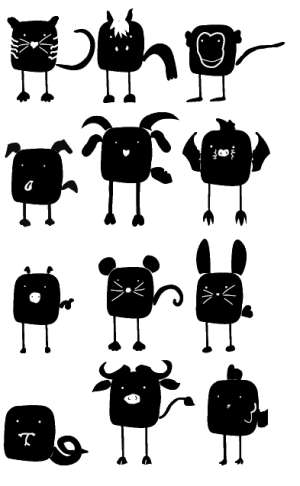
| Twelve animals of Chinese New Year |
|---|
| Illustration credit: Márcia Novais / CC licence |
Eto (干支) is the Chinese zodiac. Two sets of ordinal numbers have been used from long ago in China and East Asia. Years have been counted using a pair of numbers from the sets. One sequence consists of ten elements: elder wood, younger wood, e. fire, y. fire, e. earth, y. earth, e. metal, y. metal, e. water and y. water. The other sequence consists of twelve animals: rat, ox, tiger, rabbit, dragon, snake, horse, sheep, monkey, bird, dog, and wild pig.[1]
Each year is named as the combination of two characters, each of which is taken from one of two sets. So, there are 60 combinations used to represent a year. See also What is the Jikkan jūnishi?
The usage of "eto" has long history. In ancient historical records, only eto was used to represent a year, so historians may have to guess which year a record refers to.
Eto is no longer used in its original form in contemporary Japan. Only the animal part is used. For example, in the "dog" year, many New Year's greeting cards have pictures or drawings of dogs. Some people take the animals of their birth year into account in fortune telling.
Edited from posts by Funatsu Kunihiro and NAKANO Yasuaki. Thanks to Bart Mathias and muchan for filling in some of the names above.
Copyright © 1994-2025 Ben Bullock
If you have questions, corrections, or comments, please contact Ben Bullock or use the discussion forum / Privacy policy
|
|
|
|
|
| Book reviews |
Convert Japanese numbers |
Handwritten kanji recognition |
Stroke order diagrams |
Convert Japanese units |