
reading down from the upper right
|
|
| A mouse mat with an "iroha" pattern, reading down from the upper right |
|---|
Iroha (いろは) is a kana ordering based on a poem which contains each kana once. This ordering is still used today, and it is not unusual to see items numbered i, ro, ha where English would use A, B, C, etc. However, in dictionaries and other lists of words, it is much less common nowadays than the more regular gojūon ordering. See What is the origin of the gojūon kana ordering? for the origin of hiragana and katakana.
There are several different versions of the ordering corresponding to different versions of the poem. The most common one is
| i | ro | ha | ni | ho | he | to |
| chi | ri | nu | ru | wo | ||
| wa | ka | yo | ta | re | so | |
| tsu | ne | na | ra | mu | ||
| u | wi | no | o | ku | ya | ma |
| ke | fu | ko | e | te | ||
| a | sa | ki | yu | me | mi | shi |
| we | hi | mo | se | su | (n) |
Andrew Nelson gives the following explanation of the poem underlying this ordering:[1]
Colors are fragrant, but they fade away. In this world of ours none lasts forever. Today cross the high mountain of life's illusions [i.e., rise above this physical world], and there will be no more shallow dreaming, no more drunkenness.To get that meaning, however, you need to read it as
Iro wa nioedo
Chirinuru o
Waga yo tare zo
Tsune naran
Ui no okuyama
Kyō koete
Asaki yume miji
Ei mo sezu.
|
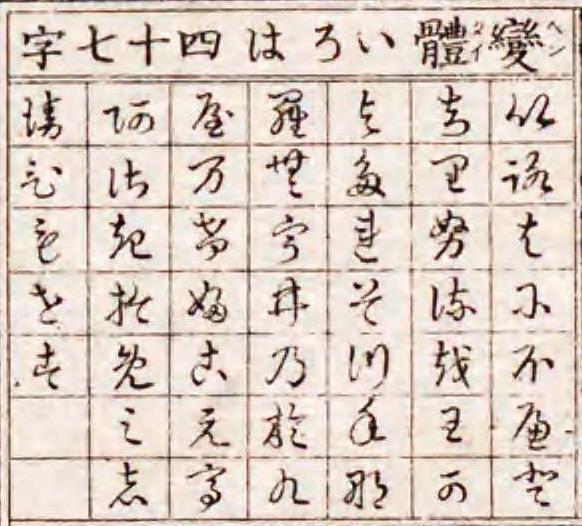
| Iroha written in hentaigana, from Genkon Jidō Jūhōki (現今児童重宝記), published in 1886. See What is hentaigana? for more about hentaigana. |
Copyright © 1994-2026 Ben Bullock
If you have questions, corrections, or comments, please contact Ben Bullock or use the discussion forum / News / Privacy policy
|
|
|
|
|
| Book reviews |
Convert Japanese numbers |
Handwritten kanji recognition |
Stroke order diagrams |
Convert Japanese units |