In Japanese, the name of Japan is Nihon or Nippon. Either form is written 日本 in kanji. These two characters mean "sun" and "origin", and "Nihon" means "origin of the sun", in other words "the land of the rising sun". The reason Japan refers to itself in this way is that Japan is east of China, and from China the sun rises from Japan.
The earliest record of the name "Nihon" appears in the Chinese historical records of the Tang dynasty, the Old Book of Tang, kutōjo (旧唐書) in Japanese. At the start of the seventh century, a delegation from Japan introduced their country as Nihon. Prince Shotoku, the Regent of Japan, sent a mission to China with a letter in which he called himself 'the Emperor of the Land in which the Sun rises'. Thus Nihon might have originated in this period. The reading of the message in Japanese is:
Hi iduru tokoro no Tenshi, Sho wo Hi bossuru tokoro no Tenshi ni itasu. Tsutsuga nakiya?
which means
"The Emperor of the land where Sun rises sends a letter to the Emperor of the land where Sun sets. Are you healthy?"
This letter was sent in the early period of the 7th century, either 605, 608 or 612. The message is recorded in the official history book of the Sui dynasty.
The alternative reading Nippon is often used. Japanese bank notes use "Nippon" rather than "Nihon". Japanese sports fans at international matches chant Nippon rather than Nihon.
For the origin of the English name Japan, see Where does the name Japan come from?
In ancient Chinese geography, Japan was called 倭 (pronounced wa in Japanese). An ancient Chinese history book from the Tang dynasty calls Japan Wa. Mention of wa also occurs in China's 'Sangoku-shi' (三国志) in the section commonly referred to as Gi-shi Wajin-den, which the 'Romance of the Three Kingdoms' is based on. This character means obedient, gentle, or meek. So it's not a bad word, though not so good. The ancient Japanese, however, hated the name because it resembled another character, 矮, meaning 'dwarf'.
The first "wa" kanji was later replaced with 和 (wa) meaning "harmony".
Yamato was originally a Japanese government area in Nara. The kanji are taken from the second version of wa above.
The Japanese never used this term. It is the modern Japanese reading of characters in a Chinese document relating to an expedition to Japan. It is highly likely that what the Chinese were trying to record was the Japanese word Yamato.
This is the kun-yomi (native Japanese reading) of Nippon/Nihon. See Why do kanji have several different pronunciations? for more about kun-yomi and on-yomi.
Fusō, which also means "hibiscus", was a Chinese name for Japan. The hibiscus was also a legendary plant which lived on an island in the Pacific where the sun was supposed to originate from. This legendary fusō first appeared in a historical book in the Song dynasty, which started in 960 A.D. After that, the name changed to mean Japan, so the origin is relatively new. A Japanese historical book (Fusō Ryakuki) was written in the Heian era (794-1185), so the word was imported to Japan at the latest in the 12th century. Nihon is older than Fusō. Probably Fusō was used as a poetic name for Nihon.
The English name "Japan" seems to come from the time of Marco Polo. See Where does the name Japan come from?
Prefixes and abbreviations used to denote "Japan" include Wa (和), Nichi (日), and Hō (邦).
|
|
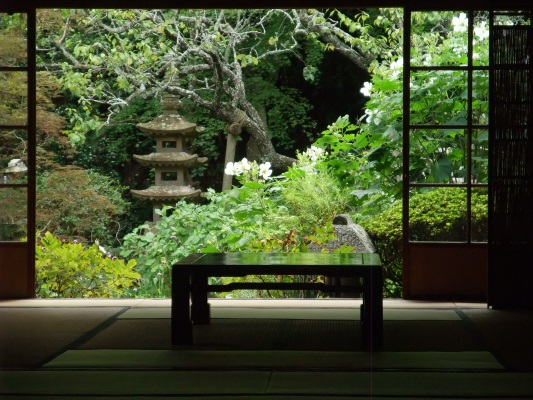
| A wa-shitsu (Japanese style room). Photo: Kimura2 |
|---|
The form Wa, meaning "harmony", is used as a prefix meaning "Japanese" in words such as wafū (和風), "Japanese style", washitsu (和室), "Japanese style room", or wasei (和製), "made in Japan". See also What are these pseudo English words like salaryman?
The form Nichi (sun or day) is used in abbreviations for politics and international relations, for example nichibei (日米) "Japan-America", or rainichi (来日) "coming to Japan". See also Why is America called bei?
The suffix Hō (邦) is used in words such as hōgaku (邦楽), "traditional Japanese music", hōga (邦画), "Japanese films", (compared to 洋画, "foreign films"), and hōjin (邦人), "a Japanese citizen in a foreign country".
J, an abbreviation of "Japan", is used in "JR" for "Japan railways", "J League", the Japanese professional football league, and many other places.
This answer was edited from posts by very many people. Special thanks to NAKANO Yasuaki and Bart Mathias for several corrections and additions.
Copyright © 1994-2026 Ben Bullock
If you have questions, corrections, or comments, please contact Ben Bullock or use the discussion forum / News / Privacy policy
|
|
|

|
|
| Book reviews |
Convert Japanese numbers |
Handwritten kanji recognition |
Stroke order diagrams |
Convert Japanese units |