|
|
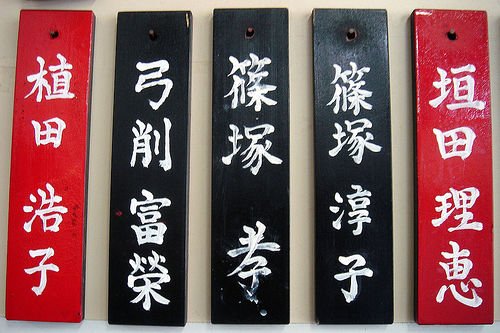
| Japanese names on a noticeboard |
|---|
| Photo credit: Angie Harms / CC licence1 |
Japanese people have two names, a surname and a given name. The surname is usually inherited from the father, and women usually change their surname to the husband's upon marriage.
In Japanese, the surname comes before the given name. Thus, a person with surname Yamamoto and given name Sanae is referred to as Yamamoto Sanae. In the name order of English, this would be "Sanae Yamamoto".
Japanese names are usually written in kanji (Chinese characters, see Kanji). Surnames are almost always in kanji. Given names are usually in kanji. Some given names are in hiragana or katakana (see Hiragana and katakana).
Japanese people do not have middle names, and middle names are not recognized in Japan, except for foreigners. See Do Japanese people have middle names?
There are a great number of surnames in Japan. The Enamdict electronic dictionary of Japanese names contains more than 138,500 surnames.[1]
Surnames are usually written in kanji (Chinese characters). Typical surnames have two characters. For example Suzuki (鈴木) or Yamamoto (山本). They may also have only one kanji, like Hara (原) or Tokoro (所), or more than two.
Most surnames are relatively easy to read, but there may be more than one way to read the same kanji spelling. For example 中田 may be read either as Nakata or Nakada. Some are very difficult, such as 八月一日, which appears to read hachigatsu tsuitachi, "the first of August", but is read Hozumi.
Some Japanese use traditional forms of characters in their surnames rather than the modern simplified forms (see Why do some kanji have alternative forms?).
Many surnames are also place names, and the rules for forming names follow similar patterns.
Some of the typical kanji used in surnames are
| Romanization | Kanji | Meaning | Examples |
|---|---|---|---|
| asa | 浅 | shallow | Asada (浅田), the surname of figure skater Mao Asada |
| mae | 前 | front | Maeda (前田), the surname of idol Atsuko Maeda |
| yoko | 横 | side | Yokoyama (横山), the tyre manufacturer |
| nishi | 西 | west | Nishikawa (西川), the surname of comedian and politician Kiyoshi Nishikawa |
| kita | 北 | north | Kitano (北野), the surname of film director and comedian "Beat Takeshi". |
| kuro | 黒 | black | Kurosawa (黒澤), the surname of film director Akira Kurosawa, famous for "Seven Samurai", meaning "black swamp" |
| iwa | 岩 | rock | 岩谷 (Iwatani), the surname of Toru Iwatani, video game designer who created "Pac-Man" |
| ishi | 石 | stone | Ishibashi (石橋) "stone bridge", the name of the founder of the "Bridgestone" company |
| matsu | 松 | pine | Matsumoto (松本) "under the pine tree", the surname of pop star Jun Matsumoto of Arashi and Kiyoshi Matsumoto, founder of the drug store chain "Matsumoto Kiyoshi". |
| sugi | 杉 | cedar | |
| take | 竹 | bamboo | |
| ki | 木 | tree | Kinoshita (木下) |
| ita | 板 | board | |
| yone | 米 | rice | Yonekura (米倉) "rice store", the surname of model and celebrity Ryoko Yonekura. |
| hayashi, bayashi | 林 | woods | Kobayashi (小林), "small woods", the name of a famous Japanese physicist, Nobel prize winner in 2008. |
| ue, kami | 上 | upper | Murakami (村上), the surname of novelists Haruki Murakami and Ryu Murakami. |
| shita, shimo | 下 | lower | Matsushita (松下), "under the pine tree", the common surname and name of the big electronics company. |
| hashi, bashi | 橋 | bridge | Hashimoto (橋本), "near the bridge", the surname of the ex-prime minister Ryutaro Hashimoto. |
| mori | 森 | forest | Morita (森田) "forest rice field", the surname of Akio Morita, founder of Sony. |
| tsuka | 塚 | mound | Tezuka (手塚), "hand mound", the surname of comics artist Osamu Tezuka. |
| mizu | 水 | water | Mizutani (水谷), the husband and wife authors of Japanese textbooks. |
| moto | 本, 元 | near | Morimoto (森本), "near the forest" |
| naka | 中 | in | Nakata (中田), "in the rice field", the surname of the professional footballer |
| uchi | 内 | in | |
| yama | 山 | mountain | Yamamoto (山本), "near the mountain" |
| oka | 丘, 岡 | hill | Okada (岡田) |
| saka | 坂 | slope | Sakamoto (坂本), the surname of Ryuichi Sakamoto, the musician |
| no | 野 | plain | Noguchi (野口), the surname of Hideo Noguchi, the scientist featured on 1,000 yen banknotes. |
| ike | 池 | pond | Koike (小池), "small pond", the surname of celebrity Eiko Koike. |
| kawa | 川 | river | Kawabata (川端), "river edge", the surname of novelist Yasunari Kawabata, who wrote "Snow Country". |
| tani | 谷 | valley | Tanizaki (谷崎), "valley edge", the surname of novelist Junichiro Tanizaki. |
| sawa, zawa | 沢 (澤) | creek | Ozawa (小澤), "small creek", the surname of conductor Seiji Ozawa. |
| numa | 沼 | marsh | |
| hata | 畑 | crop field | |
| ta, da | 田 | rice field | Honda (本田), the car manufacturer (named after its founder). |
| shima, jima | 島 (嶋) | island | Matsushima (松島), the surname of Japanese actress Nanako Matsushima, star of "The Ring" |
| mura | 村 | village | |
| saki, zaki | 埼 | cape/edge | Kawasaki (川崎), the company famous for motorcycles |
The character 藤, meaning "wisteria", is often used, pronounced either as fuji, as in Fujiwara (藤原), the surname of actress Norika Fujiwara, or as tō/dō as in Kondō (近藤) and Satō (佐藤).
In Japan, the given name is used very rarely except for children. Most of the time, people are referred to using their surname only.
Japanese personal names are usually written in kanji, although some people, usually women, may have all or part of their name in hiragana or katakana. Some name kanji are ateji chosen to match the syllables of the child's name. See Why do some gairaigo words have kanji? for more about ateji.
Many Japanese personal names are difficult to read or ambiguous. Forms which require filling in of a name usually also require a phonetic guide to be written, called furigana (see What is furigana?). Japanese politicians often use hiragana versions of their names, rather than kanji ones. See Why are election candidates' names written in hiragana?
The kanji which may be used in personal names are regulated. The Jinmeiyō and Jōyō Kanji lists are the basis of characters which are permitted (see What are the Jōyō Kanji?). Registration of some names has been refused, for example one family was refused when they tried to name their son Akuma (悪魔), meaning "demon". However, there is no regulation on what pronunciation may be given to the kanji names.
Names ending in hiko, such as Katsuhiko (勝彦), suke, such as Keisuke (慶介) or hei, such as Junpei (淳平), are usually male. Male names also often end in o, written in kanji as 夫, 雄, or 男, as in Teruo (輝夫) or Akio (昭雄), or shi, as in Atsushi, Takashi, or Kiyoshi. Male names tend to contain characters such as 勇, meaning "brave", 勝, meaning "win", or 正, meaning "correct".
Boys may be named by a numbering system, with the Chinese character for "one" appearing in the name of the first son, the character for "two" appearing in the second son's name, and so on. Novelist Kenzaburo Oe (Oe Kenzaburō (大江健三郎) is the "third son".
| Number | Chinese character | Pronunciation | Example |
|---|---|---|---|
| 1 | 一 (one) | ichi, kazu | Ichiro (一郎), Tomokazu (友一) |
| 2 | 次 (next), 二 (two) | ji | Jirō (次郎), Kōji (浩二), forename of soccer player Koji Nakata. |
| 3 | 三 | zabu, zō | Kenzaburō (健三郎), Zenzō (善三) |
| 4 | 四 | shi | Shirō |
| 5 | 五 | go | Gorō (五郎) |
Common names ending in -ichi or -kazu include
Eichi, Gen-ichi, Jun-ichi, Ju-ichi, Ken-ichi, Koichi, Kyoichi, Ryoichi, Ryuichi, Seiichi, Sen-ichi, Shin-ichi, Shoichi, Shuichi, Shun-ichi, Yoichi, Yu-ichi, Akikazu, Hidekazu, Hirokazu, Masakazu, Nobukazu, Shigekazu, Takakazu, Tomokazu, Toshikazu, Yasukazu, Yoshikazu
Sometimes succeeding sons are named using the same kanji characters plus the numbering.
Other Japanese male names include
Akihiko, Akihiro, Akihito, Akira, Fumio, Fumihiko, Hideaki, Hidekazu, Hirofumi, Hirohisa, Hiroshi, Hisashi, Hitoshi, Jotaro, Katsuhiko, Katsumi, Kazuhiko, Kazuki, Kazunori, Kazuo, Kazushi, Kei, Ken, Kensaku, Kosaku, Kotaro, Mamoru, Manabu, Masafumi, Masaharu, Masahiko, Masahiro, Masaki, Masami, Masao, Masashi, Masayoshi, Akio, Michihiro, Michio, Naoki, Noboru, Nobuhisa, Nobuo, Nobuyoshi, Noriaki, Norihide, Norihisa, Norio, Osamu, Rintaro, Ryosei, Ryutaro, Satoru, Satoshi, Shigeaki, Shigeki , Shintaro, Sumio, Masayuki, Tadao, Tadashi, Takaaki, Takafumi, Takahiro, Takao, Takashi, Takayuki, Takeshi, Takuya, Taro, Teruo, Tetsuhiko, Tetsunori, Tetsuo, Tetsuya, Tetsuyuki, Tomohiko, Tomoyuki, Toru, Toshiharu, Toshio, Toshiyuki, Tsutomu, Yoshifumi, Yoshimitsu, Yoshiyuki, Yukio, Yutaka
Names ending in e, yo, mi, usually written 美 and ko, written 子, are usually female. For example, a combination of tomo and these endings, as in Tomoe, Tomoyo, Tomomi or Tomoko, produces a typical Japanese female name. Other typical female endings include na, such as Haruna, and ka, such as Haruka. Female names are more likely to be written in hiragana than male names.
Many modern female names end in -ko, which means "child." For example
Aiko, Akiko, Asako, Atsuko, Ayako, Chikako, Emiko, Eriko, Etsuko, Fujiko, Fumiko, Haruko, Ikuko, Junko, Katsuko, Kazuko, Keiko, Kimiko, Kumiko, Kyoko, Machiko, Maiko, Makiko, Mamiko, Mariko, Masako, Mayako, Mayuko, Mayoko, Michiko, Mihoko, Minako, Misako, Mitsuko, Miyoko, Momoko, Mutsuko, Nahoko, Namiko, Nanako, Naoko, Natsuko, Nayoko, Noriko, Reiko, Rieko, Rikako, Rinako, Risako, Ritsuko, Rumiko, Ryoko, Sachiko, Saeko, Sakiko, Sakuko, Sakurako, Sanako, Satoko, Sayoko, Shoko, Seiko, Tadako, Takako, Tamiko, Tokiko, Tomiko, Yoko, Yoshiko, Yukako, Yukiko, Yumako, Yumiko, Yuriko,
Some female names end in -mi, which usually means "beauty." For example Ami, Asami, Emi, Harumi, Honami, Kazumi, Kumi, Manami, Mami, Masami, Masumi, Mayumi, Mutsumi, Nami, Nanami, Naomi, Narumi, Natsumi, Nomi, Remi, Romi, Satomi, or Yumi.
Other common names include Ai, Akane, Aki, Arisa, Ayame, Chiaki, Chika, Chisato, Ema, Eri, Fumie, Fumiyo, Hatsue, Hatsuyo, Ikue, Isako, Izumi, Jun, Katsue, Kazue, Machi, Madoka, Mai, Maki, Mari, Maya, Mayu, Mayo, Miho, Mina, Mio, Misa, Misato, Miya, Mizuki, Naho, Namie, Namiyo, Nana, Nao, Rie, Rina, Risa, Rui, Sachi, Sae, Saki, Sakura, Saya, Sayuri, Sayo, Shinobu, Shiori, Tamiyo, Tokie, Tokiyo, Yayoi, Yu, Yui, Yuka, Yukari, Yuki, Yuma, and Yuri.
Personal names are often chosen so that the stroke count of the kanji in the child's name will be a fortuitous number. This form of fortune-telling is called Seimei Handan (姓名判断).
Names for foreigners are usually written in katakana as are other foreign words. See How do I write an English word in Japanese? for the rules of transcription. See What is katakana used for? for more about when katakana is used. Chinese and Korean people, who have names based on kanji, may also be referred to by their kanji names, often with a Japanese pronunciation.
Copyright © 1994-2026 Ben Bullock
If you have questions, corrections, or comments, please contact Ben Bullock or use the discussion forum / News / Privacy policy
|
|
|
|
|
| Book reviews |
Convert Japanese numbers |
Handwritten kanji recognition |
Stroke order diagrams |
Convert Japanese units |