|
|
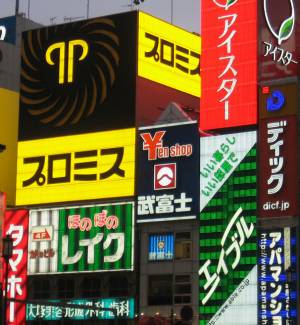
| Katakana signs |
|---|
| Photo credit: Sébastien Bertrand / CC licence |
Japanese has two forms of phonetic (sound-based) writing, hiragana and katakana. In modern Japanese, most writing is done in a mixture of hiragana and kanji (Chinese characters). The other script, katakana, is used for example to indicate loan words from languages like English, the names of animals and plants, for some company names, such as Suzuki, and for emphasis. The following paragraphs detail most of the uses of katakana.
Katakana is used for transcription of loan words from foreign languages. For example, "tomato" is written トマト (tomato). Similarly "America" is written アメリカ (amerika) and "John" is written ジョン (jon).
Katakana is often used for company names. For example the car manufacturer Suzuki is スズキ, and Mitsubishi is ミツビシ.
Katakana is used for emphasis, especially on signs and advertisements. For example, ゴミ, gomi (rubbish), or メガネ, megane (glasses).
Japanese contains many words borrowed from Chinese or formed from Chinese elements. These words are usually written in kanji. However, words from modern Chinese are often written in katakana. For example, mahjong, mājan may be written written マージャン rather than kanji 麻雀, or oolong tea, ūroncha may be written ウーロン茶 rather than kanji, 烏龍茶.
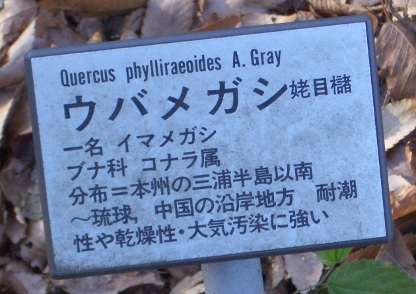 |
| Tree name sign in a park |
|---|
The names of animal and plant species and minerals are commonly written in katakana. See How are animal and plant names written in Japanese?
Katakana is sometimes used to indicate words being spoken in a foreign accent or "robotic" speech. For example, in a cartoon, the speech of a foreign character or a robot may be represented by コンニチワ ("konnichiwa") instead of the more usual hiragana こんにちは ("konnichi wa").
Katakana is sometimes used instead of hiragana as furigana (see What is furigana?). Katakana are often used to indicate the on-yomi readings (see Why do kanji have several different pronunciations?) of a kanji in a kanji dictionary (see How is a kanji dictionary used?).
Words with uncommon kanji are sometimes partly written in katakana. For example, in the word "dermatologist", hifuka (皮膚科), the second kanji, 膚, is quite complex, and thus the word is commonly written as 皮フ科, with the second character in katakana only.
Katakana is used to represent sounds. For example hii (ヒー), meaning "sigh" is usually written in katakana, as are the calls of animals (see What noises do animals make?).
Some personal names are written in katakana, especially female ones. This was more common in the past, hence women of past generations often had katakana names such as セツ (Setsu). This is less common today. Nowadays most female babies are given kanji or hiragana names.
Telegrams are written in katakana, and before the introduction of multibyte characters in computer systems in the 1980s, computer output was entirely in katakana. The Japanese banking system still requires account names to be in katakana. See What is half-width katakana? and Encodings of Japanese for more on early computer encoding schemes.
Historically, katakana was used in a different way. Until the end of World War 2, official documents used a mix of katakana and kanji in the same way that hiragana and kanji are mixed in modern Japanese texts, that is, katakana were used for okurigana (see What is okurigana?) and particles (see Particles (助詞)) such as wa or wo.
To see how a particular English word is represented in katakana, try the following tool which converts English into katakana based on a dictionary of pronunciations:
Copyright © 1994-2026 Ben Bullock
If you have questions, corrections, or comments, please contact Ben Bullock or use the discussion forum / News / Privacy policy
|
|
|
|
|
| Book reviews |
Convert Japanese numbers |
Handwritten kanji recognition |
Stroke order diagrams |
Convert Japanese units |