| sci.lang.japan FAQ / 1. Writing / 1.3. Other questions on writing | Search: |
|
|
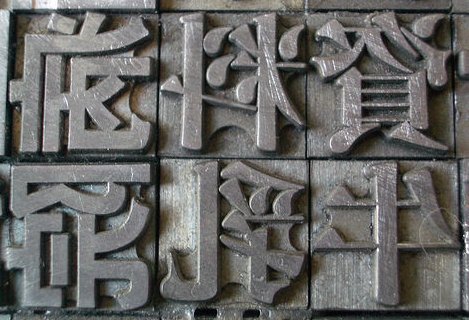
| Metal kanji for printing |
|---|
|
Photo credit: Matt Smith
Used under a Creative Commons licence. |
There are two main styles of writing Chinese characters,
The oldest surviving Chinese characters were written on turtle shells and bones, and perhaps used for divination.
The second oldest type of Chinese characters were found engraved on
bronze vessels, hence the name kin (metal) bun (word).
This style is still used for making seals (hanko, inkan)
(see 9.8. How do the Japanese sign their names?). There are two variations, daitenshotai (大篆書体), created in the Zhou (Japanese shuu, 周) era, and
shoutenshotai (小篆書体), created in the Song (Japanese
Shin, 秦) era.
This style is square and simple in form. It is a simplified version of
shoutenshotai. The rei (隷) in reisho means a minor
official, hence this style is sometimes called "clerk style" in
English.
This is a name for an older version of the reisho style.
This is the classic printed style. Minchou means "Ming
dynasty". This type style is characterized by
This style of writing, used for newspapers is a variant of Minchou font designed for readability at small scales.
This style is similar to sans-serif type in English. The name
goshikku is derived from English "gothic", but it has very little
in common with "gothic" type in English. In the past, the word
"gothic" was used to describe sans-serif typefaces. This meaning,
"sans serif", has been preserved in the Japanese usage.
A development of the goshikku typeface with rounded corners (Japanese maru (丸) means "round") on the kanji. This typeface is used on road signs.
Google Images: "丸ゴシック体"This style was created in the Meiji era for use in primary school textbooks. It resembles hand-written characters. It is a variant of the kaisho style made easier to read. It is often used in primary school textbooks. This style is also used in the "Genki" textbook series for learning Japanese.
This style, originally created for use in woodblock printing, closely resembles the kaisho style.
This
style is used in rakkan (落款) or seals. It was invented in
Japan in the Heian or Nara eras.
mouhitsushotai (毛筆書体)
The most traditional square style of characters, with horizontal lines
slanting upwards going from left to right. The kai in kaisho
means "regular".
A "cursive", flowing style of writing using a brush.
This is a more modern version of the
This is an even more flowing style than gyoushotai. This style was the basis for the origin of hiragana. See 1.1.1. How did katakana and hiragana originate? Characters written in this style may be impossible to read without special training.
|
| A chouchin |
|---|
|
Photo credit: Stardog Champion (real name unknown)
Used under a Creative Commons licence |
This general term covers many Japanese lettering styles which were invented mostly for advertising purposes in the Edo period. For example,
This style is strongly associated with arts like kabuki and
rakugo.
The
name yosemoji literally means "letters to draw in customers".
This name literally means "cage letters". The font is thick and square in shape.
These characters have little "whiskers" on them.
This style is the one used for sumo wrestling posters.
These characters are the ones used on chouchin, hanging paper lanterns, such as the ones you might see outside a yakitori stand in Japan.
Google Images: "提灯文字"This very heavy, rectangular style is used for making seals.
Google Images: "角字"
|
| Example of POP typeface |
|---|
Shoujomoji literally means "young girl letters", and the
style is a copy of a feminine style of writing.
This is the style of writing used for movie subtitles. The letters are actually written by hand directly onto the 35 mm film by specially trained people called "title writers". The actual characters are less than one millimetre in size, and the special look of this style, and its heavy use of abbreviated kanji forms, are due to the restrictions imposed by space.
Thanks to Jeff Schrepfer, Kouji Ueshiba, seto-san for help with this entry.
Copyright © 1994-2010 Ben Bullock
If you have questions, corrections, or comments, please contact Ben Bullock or use the discussion forum / Privacy